
A cheap office can become expensive very quickly if it slows hiring, weakens team coordination or locks the business into the wrong cost base. That is why office space is not just a property decision. For founders and SME leaders, it is an operating decision with direct effects on cash flow, productivity and how credible the business looks to clients, staff and partners.
The mistake many firms make is treating the search as a choice between price and prestige. In practice, the better question is whether the space fits the business you are running now and the one you expect to be running in 12 to 24 months. If the answer is no, even a good-looking deal can turn into disruption.
What good office space actually does
The right office space supports daily work without creating friction. That sounds obvious, but it is where many businesses go wrong. A space may look smart on a viewing and still fail on basic operational points such as meeting room access, noise levels, broadband reliability, storage, parking or ease of commuting.
For a small team, office space often needs to do several jobs at once. It may be a headquarters, a client-facing venue, a collaboration hub and a place to build routine for hybrid staff. Those functions do not always sit comfortably together. A sales-led business may need polished meeting areas and a central address. A technical team may care far more about quiet zones, secure access and room for equipment. A professional services firm may need privacy and flexibility in equal measure.
That is why office choice works best when it starts with workflow rather than square footage. Before comparing rents, define what the space must help the team do each week.
Start with business needs, not the floorplan
A practical search begins with a simple operational review. How many people need to be in the office at the same time, not how many are on payroll? How often do clients visit? Which roles need quiet concentration and which need frequent interaction? Do you expect the team to grow, contract or change shape over the term of the lease?
These questions matter because office space is often bought on assumptions that are already out of date. A business that moved to hybrid working may no longer need a desk for every employee, but it may need more collaboration areas. A company planning international growth may need less permanent room than expected if new hires will be remote. On the other hand, a firm struggling with supervision, training or culture may need a stronger in-person base than leadership first imagined.
There is also a timing issue. Taking too much space too early ties up capital. Taking too little can force a second move within a year, which is costly and distracting. For growing firms, some spare capacity is sensible, but only if the price of that flexibility is proportionate.
Location still matters, but for different reasons
Location has not become irrelevant because hybrid work is common. It has simply become more specific. The old assumption that every business needs the most central address it can afford no longer holds. What matters is whether the location supports recruitment, retention, client access and operating efficiency.
For some businesses, a central business district still carries real value. It can help with brand perception, make meetings easier and reduce travel friction for senior staff and clients. For others, edge-of-city or suburban sites may be stronger on cost, parking and convenience. If your team commutes from multiple directions, a location near major rail links may outperform a fashionable postcode.
The trade-off is rarely just between rent levels. Cheaper space in the wrong place can lead to higher travel costs, weaker attendance and a smaller talent pool. More expensive space can be justified if it improves hiring or helps win revenue. The right answer depends on how your business makes money and how your people actually work.
Lease length, flexibility and hidden costs
This is where otherwise sensible decisions often start to unravel. Rent is only part of the cost of office space. Service charges, business rates, utilities, insurance, fit-out, furniture, cleaning, internet, repairs and dilapidations can materially change the numbers.
A conventional lease may offer lower headline rent than a serviced office, but that does not automatically make it better value. If the business needs to invest heavily in fit-out, commit for several years and manage multiple suppliers, the real cost may be higher than expected. A serviced office usually bundles more into one fee and reduces setup time, but the premium can rise sharply as headcount grows.
Flexibility has value, especially in uncertain markets. Break clauses, shorter terms, expansion options and assignment rights can protect the business if plans change. That said, flexibility is rarely free. Landlords price risk, and shorter commitments often mean higher monthly costs. The right balance depends on how predictable your revenue and staffing plans are.
A good rule is to model three scenarios before signing anything: current headcount, moderate growth and downside pressure. If the office only works financially in the best-case scenario, it is probably the wrong deal.
The layout question many firms underestimate
An office can be the right size and still perform badly. Layout shapes how people use the space, how often they interrupt one another and whether managers can supervise effectively without creating a sense of being watched.
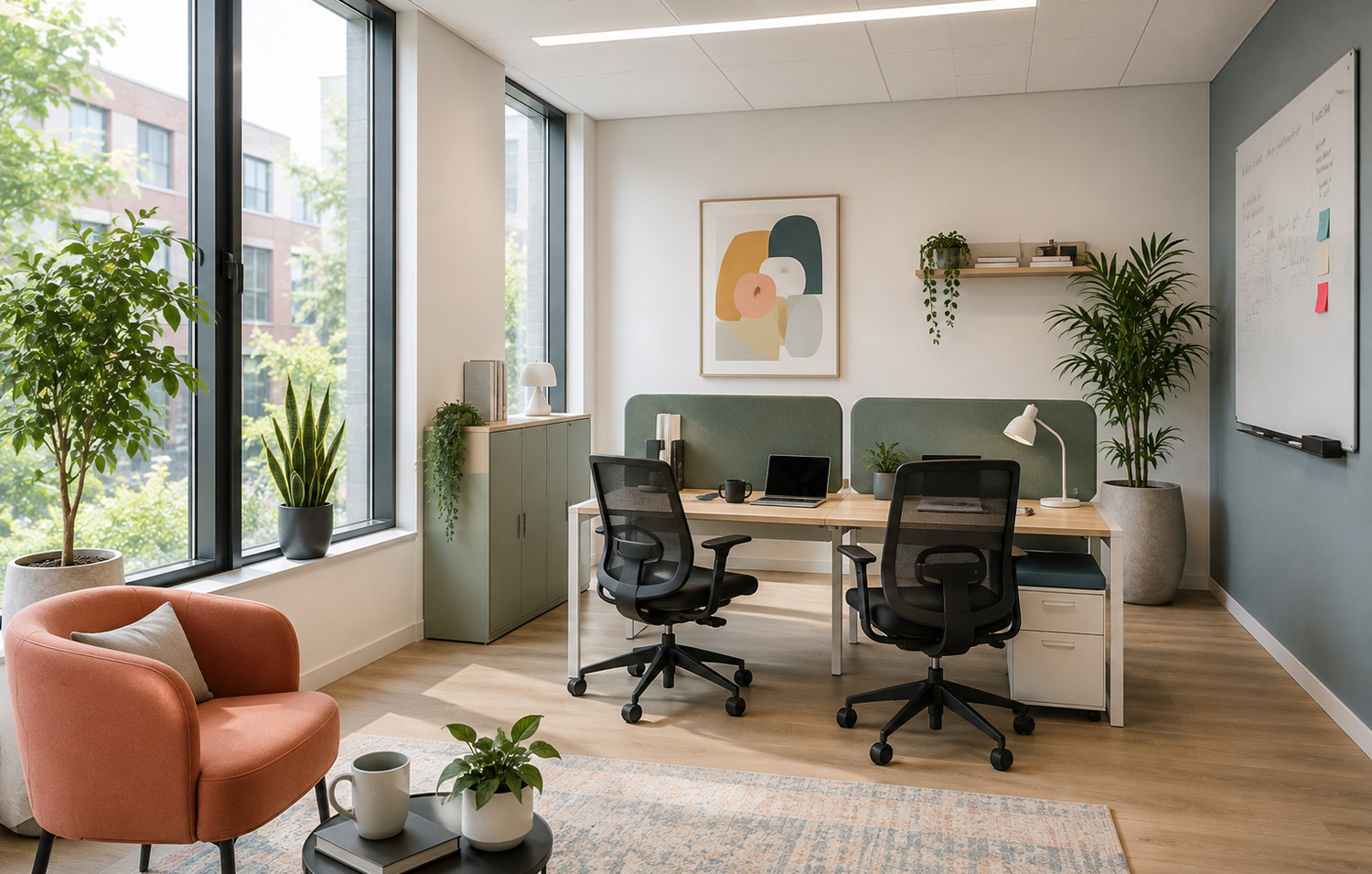
Open-plan offices suit some teams and frustrate others. They can encourage quick communication, but they also increase noise and reduce privacy. Private rooms improve focus and confidentiality, but too many walls can isolate staff and waste valuable area. Most modern businesses need a mix: shared working zones, a few enclosed rooms, places for informal conversations and reliable video-call space.
This matters even more in hybrid teams. When some staff are remote and others are in the office, poor layout quickly shows up in awkward meetings, poor acoustics and avoidable delays. If calls are part of daily work, dedicated booths or small rooms are not a luxury. They are basic infrastructure.
Furniture and ergonomics deserve similar attention. A smart reception area means little if staff are working on unsuitable desks and chairs. Over time, that affects comfort, morale and absence risk.
Serviced, leased or coworking?
There is no universal best option, only a best fit.
Serviced office space suits businesses that need speed, predictable setup and less administrative burden. It is often attractive for younger companies, satellite teams or firms entering a new market. The trade-off is cost per desk and less control over branding or layout.
A traditional lease offers more control and may be more economical over time for larger or stable businesses. It also brings more responsibility, more upfront spending and less room to change direction quickly.
Coworking can work well for solo operators, small teams and project-based businesses that value networking and flexibility. It can also be a useful interim step while a company tests team attendance patterns. The downside is reduced privacy, variable noise and a less tailored environment.
For many SMEs, the choice is not permanent. A business might begin in coworking, move into serviced office space as it hires, then take leased premises once team size and cash flow are predictable enough to support a longer commitment.
How to evaluate office space without wasting time
A viewing should be treated as an operational inspection, not a sales tour. Ask practical questions. What are the internet speeds and backup options? How are heating and cooling controlled? Who is responsible for repairs? What access is available outside standard hours? How often are meeting rooms actually available at busy times?
Visit at more than one time of day if possible. A quiet mid-morning viewing may tell you very little about lift delays, street noise, reception bottlenecks or whether the area feels safe in the evening. If staff will commute, test the route rather than relying on a map.
Bring someone from operations or IT if the office will support equipment, security-sensitive work or regular video conferencing. Small technical weaknesses can become daily frustrations once the team moves in.
It is also worth pressure-testing the space against real business activity. Where would onboarding happen? Where would a difficult HR conversation take place? Can two client meetings run at once without disruption? These are ordinary questions, but they reveal whether the office works in practice.
The decision should reflect strategy, not fashion
Office trends move quickly. One year the market pushes hot-desking, the next it swings back to private hubs and collaboration zones. Chasing fashion rarely helps. Your office space should reflect how the business creates value, how the team performs best and how much risk the company can sensibly carry.
That may mean choosing a modest office with excellent transport links over a more impressive address. It may mean paying more for flexibility while revenue is still uneven. It may mean accepting that a fully bespoke headquarters is unnecessary if clients rarely visit and most work is digital.
A good office decision is usually a calm one. It aligns cost with operational need, gives the business room to adapt and removes friction from the working week. For growing firms, that is often worth far more than the extra square metres on the brochure.
The best office is not the one that looks busiest or sounds most ambitious. It is the one that helps your business make better decisions, serve clients well and grow without creating avoidable drag.